Kim Brown Seely
Writer. Mariner. Coffee-drinker. Leaver-of-town.

Writer. Mariner. Coffee-drinker. Leaver-of-town.
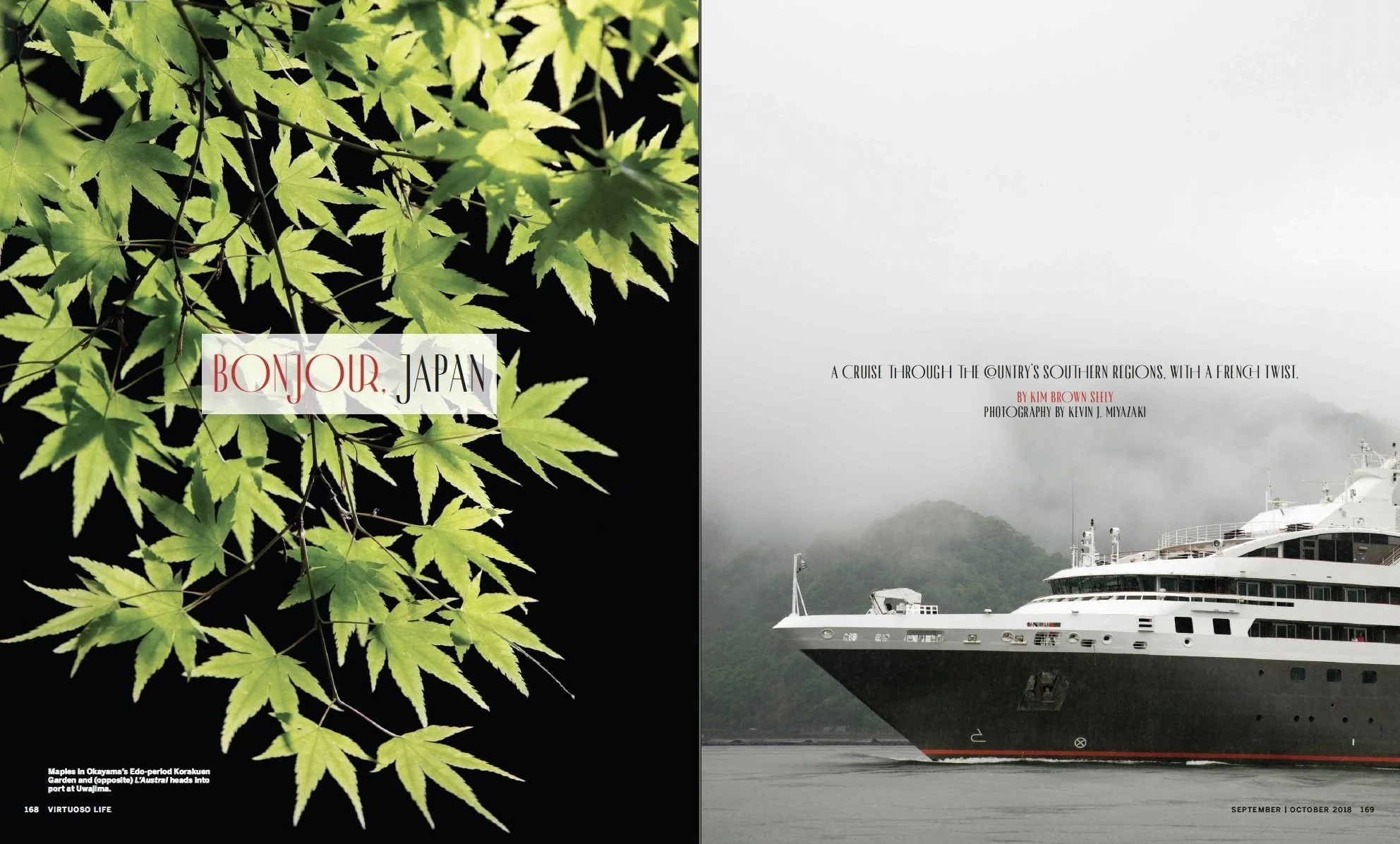
From Virtuoso Life September/October 2018. Photographs by Kevin J. Miyazaki.
The water was blue and the torii gate standing knee deep in it was red. We walked toward it on a sandy path. My sister and I could hear the rustling of the forest to our left and the whispering of the sea to our right. The moment felt ephemeral, yet eternal. Young students in navy-blue sailor uniforms schooled around us, and the scent of pines drifted past, invigorating after the ship’s climate control. But then all of it was invigorating: the rustic simplicity of the iconic red shrine – arms raised to the sacred island it’s faced for hundreds of years – and the sleek cruise ship and cabin we were sharing for a week, a floating microcosm of French chic bumping up against the rarefied beauty of Japan. It was the second day of our sailing along the country’s southern coast, and we were just beginning to grasp that each time we stepped ashore, our senses might lead us somewhere exquisite. The day before it had been a classical seventeenth-century garden with a simple teahouse and a soothing stream flowing through its raised wood floor. Now we were walking toward the vermillion-roofed pavilions of this ancient Miyajima Island temple, designed to draw your gaze not just outward but inward. With each step I tried to feel a little more Zen. But mostly I thought about how, in a chaotic world, Japanese culture is full of experiences that invite you to access something deep and unchanging. Traveling between them by sea is an elegant way to go.
On a Ponant ship, style is what strikes you first. Unabashedly French, the 264-passenger Austral has a steel-gray hull and minimalist interiors reminiscent of a Parisian boutique hotel. It feels like a mega-yacht outfitted by Emanuel Ungaro (in fact, Ponant is owned by French billionaire François Pinault’s holding company, which also owns Saint Laurent, Gucci, Boucheron, and other luxury brands). Everything inside is taupe, cream, and white, with sexy accents of smoky brown. Our cabin, No. 314, was deeply calming, with wood accents, closets and drawers trimmed in creamy white leather, a balcony, and a marble bath stocked with so many Hermès toiletries that even two sisters could share. From the moment Kristen and I stepped aboard in Osaka and were greeted – “Bonjour!” – by the buffed and polished crew handing out flutes of Veuve Clicquot, we realized we’d be cruising Japan on very French terms.
I’d always longed to visit Japan, so when the opportunity arose to bring my sister, Kristen, on an eight-day sail around the southernmost of the country’s main islands, from Osaka to Maizuru, we promptly cleared our calendars. It was the fanciest thing we’d ever done together. Dinner in the white-on-white dining room was fancy; getting dressed for drinks in the clubby sixth floor lounge was fancy; and waltzing up to breakfast and ordering a perfect latte for her and cappuccino for me, before slathering our fresh-baked baguettes with individually wrapped pats of artisanal beurre imported from Brittany, was fancy. As one of our fellow passengers put it: “There are cruises, and then there are cruises.”
The vast majority of travelers to Japan focus on Tokyo and Kyoto, never venturing past the country’s central core, but this was a chance to explore rarely visited coastal towns, spend time in cities with World War II significance, and ply the waters past myriad tiny islands in the Inland Sea. “This itinerary is interesting because it’s a different side of Japan – traditional Japan, the real Japan,” Phoenix-based Virtuoso travel advisor Toshiko Suzuki told me. “It’s not a first timer’s trip; you’ll see a part of the country very few travelers get to see.”
Japan is one of those places that feels like a conduit to what actually matters. It has an almost spiritual draw. Maybe that was the reason the Itsukushima Shrine’s iconic torii gate moved us so. Many of Japan’s loveliest shrines face the sea, and this one, a UNESCO World Heritage site first built around the sixth century off forested Miyajima Island, is a Shinto shrine. Shintoism, the millennia-old animistic Japanese religion, ascribes a spiritual essence to all things – objects, places, creatures. Nature, in particular, is revered.
As Kristen, a philosophy professor, later explained to me, “Without even touching the sacred island, it expresses honor to it.” It’s a shrine meant to be experienced outdoors, and the path, the forest, and the scent of the sea felt elemental. All we had to be was there – and there felt like everything at that moment. And yet, Itsukushima is also an ancient shrine, which makes you think about the passing of time. We were so lucky to be here! Yet even this beautiful moment is a fleeting moment! Just like the seasons. These were the kinds of thoughts we found ourselves having, suddenly, in Japan.
As seaborne pilgrims, we returned to the ship for lunch most days between optional morning and afternoon excursions. It seemed odd to travel all the way to Japan and eat French food, but it was also nice to shed our sneakers for chic little sandals and relax at a table on the sundeck between trips to the Mediterranean buffet while Julien, the cute French sommelier, tried to pour us more wine. After the first few days, we realized that if we stuck mainly to salads, we could save more room for dessert: a luscious cheese course followed by a daily parade of mousse au chocolats, crème caramels, pastries, cakes, tarts, and a dreamy concoction called îles flottantes (floating islands), clouds of poached meringue on a vanilla custard sauce. Heaven.
Our fellow passengers turned out to be a well-traveled, sophisticated bunch. In a lifetime of dinner parties, I’ve never sat next to horse breeders from Australia, a couple with a daughter who’d skied in the Sochi Olympics, a metallurgist, a sheep-ranching couple from Melbourne who hilariously explained to us how you could tell if a sheep was gay, and a retired French CEO who’d spent more time traveling around the States than we had.
Hailing from 16 different countries, we were a third French, a third American, and a quarter Australian, plus a mix of Belgians, Brazilians, Canadians, Austrians, Italians, and Swiss. Fearing a looming wardrobe crisis, Kristen and I had compared notes on what to pack for weeks before our trip. (Ponant’s website emphasized French elegance and suggested there might even be an “all-white dress night.” There wasn’t.) But once on board, the two of us had to laugh with our new girlfriends: We’d all felt the pressure to step up our wardrobes, and everyone had packed so many scarves!
The resulting dress was smart casual with a few notably French exceptions: the mysterious widow who wore patent-leather Ferragamo pumps everywhere, even on shore excursions; men in Parisian red and Riviera blue trousers, and lots of crisp white polo shirts.
That said, Kristen and I turned out to be the only two passengers who had lugged along the unabridged Tale of Genji (at 1,320 pages, it consumes a quarter of a carry-on). Murasaki Shikibu’s delicious story of eleventh- century Heian court life is not only seductive, but it’s believed to be the world’s first novel. That, and Donald Richie’s classic travel memoir, Inland Sea, proved invaluable to our nascent understanding of Japanese history and culture. In this complex country, many of the excursions were historically intense (especially those in Hiroshima and Nagasaki). The only thing I missed having on board was the typical expedition-cruise roster of evening lectures over cocktails to help process them.
One afternoon after lunch we caught a shuttle from the ship to Hiroshima’s Peace Memorial Museum. The first city in history destroyed by a nuclear weapon – the United States dropped an atomic bomb on it in 1945, near the end of WWII – Hiroshima is today a municipality of 1.2 million people. We passed Mazda’s main assembly plant, block after block of concrete apartment buildings, a huge armory-like brick structure with rusting shutters that survived the blast, and uniformed school kids riding bikes along immaculate sidewalks.
The Peace Museum’s main exhibit displays a black-and-white landscape photo of ground zero taken after the Enola Gay dropped that bomb, code-named “Little Boy.” The entire city, block after block after block, is annihilated. Nothing is left but twisted metal, blackened rubble, and scorched tree trunks.
We learned that some 140,000 lives were lost. It’s difficult to imagine anything surviving that kind of destruction, but the most moving part of the memorial was video testimony of a dozen survivors grown old. Each told their story: where they were when they saw the bright flash, and what happened next. One woman described the city in the days after, how every living thing had been erased. The only colors, she said, were black, brown, and red. There wasn’t a single green thing left, she said, not even a leaf.
The contrasts – visiting a peaceful shrine by morning and reliving the destruction of the first nuclear bomb that afternoon – were extreme. My sister and I walked part of the way back to port, and when we got there, boarding L’Austral felt oddly jarring. That night, the Hiroshima Junior Marimba Ensemble joined us and played their hearts out. There was an origami lesson (“geisha bookmark”) in the main lounge and, after dinner, a Folies Bergère-inspired show, Paris Express.
One of the best parts of the cruise, we found, was how international it w as. Although I missed having onboard experts and guides (Ponant’s cruises lean more toward lounge singers, dancers, and musicians), this was one of many evenings when engaging in lively, thoughtful conversations with our fellow cruisers from Australia and Switzerland and France over filet de veau and voiles chocolat et praliné was a welcome end to a thought-provoking day.
The elegant ship could have been all the world we needed, but our shore excursions took us to parts of Japan we’d never have seen otherwise. At the far end of Kyushu, the southernmost of Japan’s four main islands, we visited the town of Chiran, strolling a preserved samurai district with traditional houses still owned by samurai descendants. Each residence maintains a landscaped garden dating back to the Edo period (1615 to 1868). Contemplating these Zen gardens, it struck us that the serene landscapes occupied an odd part of the fierce samurai psyche, but that’s what’s so fascinating about Japan: It’s complicated.
A line of 1,036 concrete lanterns edged the road as we continued to our next stop: Chiran’s Peace Museum for Kamikaze Pilots. Each lantern represents a young pilot who embarked on a suicide mission against Allied vessels in WWII; 439 of those pilots trained here. It was sad winding up the road; entering the museum we weren’t sure what to expect, but there was no glorifying the war. If anything, the museum makes a quiet, eloquent appeal for peace.
Photos of young kamikaze pilots line the walls, along with their final thoughts, letters they wrote home the night before their flights. The goal is to put names and faces to these very young men so that nothing like this happens again.
“Here the cherry blossoms have already fallen. The young green leaves you love so much will soon usher in a new season of spring. It seems silly to talk like this at such a time, but I feel like being a bit greedy at the moment.” – Toshio Anazawa, April 12, 1945 (age 23).
When we emerged into the sunlight, we heard in the distance, thankfully, sounds of everyday life: people laughing, insects buzzing, the bus waiting. We rolled on.
As Japan struggled to rebuild after the war, the government sought to preserve the nation’s cultural legacy, including masters of specific arts or crafts. On our last day, we visited the Abe Eishiro Memorial Hall, dedicated to one of the country’s former Living National Treasures, a master of the centuries-old art form of washi papermaking. Abe Eishiro passed away in 1984, but in his humble, light-filled studio, his son taught us something about the devotion required to hand-make paper.
For my sister and me, a professor and a writer, dipping a small framed screen into a vat of pulpy water, draining it, and peeling off a peach-colored postcard felt almost religious. We dried our wet postcards on pieces of linen, admired the paper peace cranes suspended from the ceiling.
I hoped I’d remember the feeling once I got home to the States. Japan seemed everywhere a land of refined essences. And each one expressed a deeper message about how perfecting details can reveal something profound: Call it clarity or truth. Either way, as we drove back to the ship through hills lush with cedar and pine, I knew I’d treasure this time. We hadn’t even left yet, and already I wanted to return.
_______
By Kim Brown Seely. All rights reserved.