Kim Brown Seely
Writer. Mariner. Coffee-drinker. Leaver-of-town.

Writer. Mariner. Coffee-drinker. Leaver-of-town.
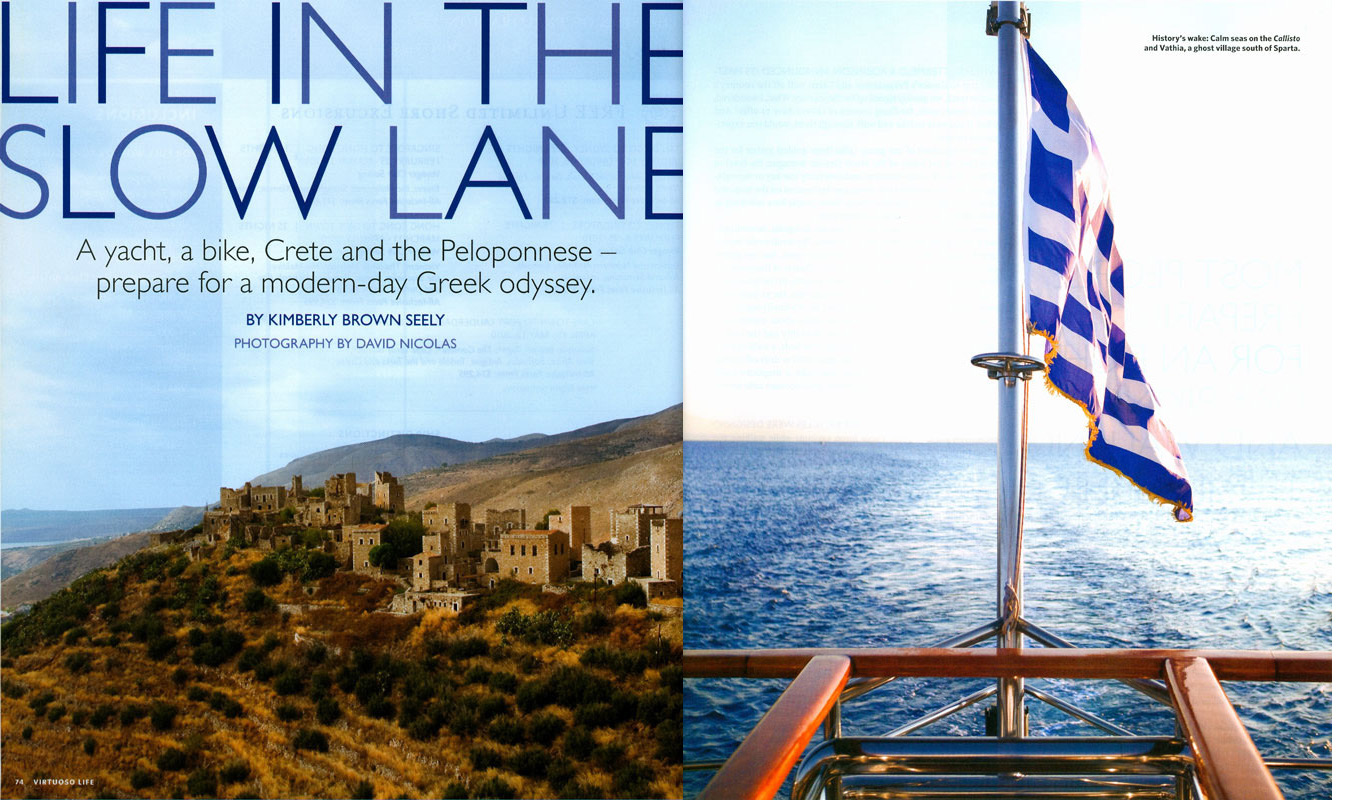
Most people about to sail where Odysseus sailed, stroll where Socrates and Plato walked, and pedal the pathways of Agamemnon and Alexander the Great, would check the weather or break in their bike shoes. Not us. We were so excited by the very idea of Greece, an idea as grand and compelling as The Iliad itself, that we somehow overlooked those minor details.
Which is how we found ourselves in the National Archaeological Museum of Athens, standing before a magnificent 600 B.C. male kouros statue, feeling anxious and middle-aged. The Greek ideals of hope, vigor, and perfection—indeed, the very foundations of Western thought—we read on the small card pasted beside the figure, were meant be expressed in these works.
“Note the plasticity of the muscles,” I read aloud, raising an eyebrow at my husband.
“It’s an ideal!” Jeff said, moving off to inspect a bronze Zeus, “but, hey, I might look like that by the end of the week.”
WHEN BUTTERFIELD & ROBINSON ANNOUNCED ITS FIRST-EVER TRIP TO GREECE’S Peloponnese and Crete, a part of the world known by few, well off the country’s tourist track, we quickly signed up for the journey. What, I wondered, would these rustic, far-flung corners of Greece have to offer sophisticated travelers? And what, if you were to bike and walk through them, would you experience in return?
The 16 members of our group (plus three guides) gather for the first time in the lobby of the Hotel Grande Bretagne, the hotel in Athens. Most of us are American and look fairly low-key in our walking clothes. But mention just about any destination on the world’s travel map, and chances are one of us has been there. Some people have taken ten or more B&R trips (one couple is on their 24th).
You can’t come to Greece and not see the Acropolis. Accordingly, our first full day is a walking tour of Athens. We stroll to the brand-new Acropolis Museum, which isn’t officially open, but our guides gain access. We sit on the stone steps of the Theatre of Dionysus. We marvel at the Parthenon. But it isn’t until we drive to the tiny harbor of Zeas and board our home for the next eight days, the 32-passenger, teak-decked Callisto, that the journey feels like it’s finally begun.
Two of the nice things (and there are many), about combining a biking and walking trip with a yacht are flexibility and the ease of unpacking only once. Our cabin contains twin beds, a walk-in bath, a closet, and a small TV–where we can wake up to CNN or drift off to Brad Pitt playing Achilles in Troy. Dinner that night is simplicity itself: tomato bisque, grilled salmon with pesto, and chocolate cake, served in the Callisto’s dining room.
“THESE CUSTOM CANNONDALE BICYCLES WERE DESIGNED exclusively for B&R,” guide Paolo Biron explains while walking the group through gear-shifting the next morning. Our first ride is rated “moderate,” and the mood of our Lycra-clad fellow cyclists is upbeat. With little fanfare we push off from the Callisto and bike toward the famed site of Mycenae, 12 miles away. After a while, Jeff and I start to get the hang of the provided route notes, which read like this:
In the small town of Argolico turn LEFT at the 3-way intersection at the small green kiosk hut that sells cigarettes, etc. If you pass “Aegean” gas station and a pink house, you’ve gone too far.
We wind through small pastoral villages and orange groves heavy with fruit. We pass town squares, backyards planted with persimmon trees, and people going about their everyday lives. Following the directions Velcroed to our handlebars is a little like a treasure hunt; it’s fun. Then comes the final ascent toward Mycenae (built on a hill, naturally). This is a long, slow push, harder than people are expecting, and although I do wish we’d trained a bit, the day is truly designed so you can ride or walk at your own pace. Eventually, everyone makes it to the top.
It’s hard to convey what’s so awe-inspiring about arriving at a place like Mycenae by bike. You’ve got dozens of tour-bus groups pulling in and streaming toward the famed Lions Gate, but this approach, powered by your own lungs and legs, makes you feel like a Greek hero. Instead of a laurel wreath? You earn a glass of just-squeezed orange juice, fresh from the trees below.
Terraced hills stretch before you. This is the actual site where Clytemnestra and her lover, Aegistheus, slew king Agamemnon. All this was once thought to exist only in ancient Greek legend and Homer’s epic poetry. But in 1876 an amateur archaeologist named Heinrich Schliemann found the fabled city and uncovered its remnants, which date back to 1350 BC; now, 3,000 later, here you are, high on endorphins. Alive and in decent enough shape, even, to ride across the rooftop of history.
After a taverna lunch of stuffed grape leaves and tomatoes, lamb, roast potatoes, and pitchers of local wine, we down Greek coffees and push off again. Despite our full bellies bound in bike shorts, we promptly realize how much we love this. Moving through a country at the pace of a bike ride is a remarkably intimate way to experience it. And what you encounter during an afternoon’s ride is, well, everything. Every single dog barking. Each rooster crowing. The road, rising and falling. The group spreads out, so it is just my husband and me riding through acres of silvery-leaved olive orchards. We pass two leathery Greek ladies—sisters maybe—out for a stroll.
“Yassas!” (hello) I try calling out to them, as our guide, Sakis, has instructed.
“Yassas,” they reply, grinning.
Suddenly every tree, each branch, snaps into focus.
PART OF WHAT MAKES A GOOD TRIP EXCEPTIONAL IS THE guides. Ours speak several languages and seem to possess superhuman patience when it comes to chasing down stray bikers or walkers.
How would this ripe green olive taste? I wonder. I stop my bike, pick one, and give it a try. Blech. Bitter!
“Ah, the original olive test,” Paolo grins a few moments later when we pedal up to an impromptu pit-stop. He has, no doubt, watched hundreds of B&R neophytes bite into unbrined olives. But he beams, nonetheless, the same way you might encourage a small child.
Our energetic lead guide, Sakis Mitsoulis, a Greek-born Toronto artist with a muscular build and a fondness for sleeveless T-shirts, likes to wear his thick black hair gelled into spikes and tells stories about the Greek gods with such immediacy you’d think they were crazy relatives. He’s been guiding trips for years, but this one is close to his heart; he spent summers at his godfather’s house on the Peloponnese. “This is where I learned to play, to smell, to taste,” he tells us. “You guys are really lucky to be here. This stuff is way past the typical tourist’s Greece.”
Days unfold with a sense of utter freedom, although the group is, of course, fully supported. Make a wrong turn? No worries, Sakis will find you. Too tired? No problem, lounge on your own private 164-foot yacht. Our toughest challenge is choosing between biking, walking, or lounging. Each night we gather in theCallisto bar, sip gin and tonics, and debate the merits of the next day’s routes. Maps are spread out. Weather is dialed in.
We cruise farther south along the Peloponnese, with the Callisto typically sailing at night. The days fall into a delicious pattern, each with its own tactile richness. Mornings begin with cappuccinos on deck followed by buffet breakfast, then the group splits into bikers and hikers. One walking day sets off from the small seaside town of Leonídion, where we pass women whitewashing front walls before 9 AM, then follow an old goat herders’ trail up a hillside overlooking town. The sky is deep blue, the temperature just right, and the breeze carries the melodic tinkling of goats’ bells. It feels good to stretch our legs. When we reach the top of the ridge and its white chapel, the Aegean spreads out far below.
OUR DESCENT FOLLOWS A 2,000 YEAR-OLD BYZANTINE STONE path that winds between stands of fragrant pine, thyme, and sage, before dropping into a lovely, silent hill town. Everywhere you look, there is some touch of “prevalent beauty,” as one of our fellow walkers puts it: a jasmine vine flowering over a rustic wooden door, a profusion of bougainvillea exploding just so, a window-frame painted the color of the sea. It’s wonderful to be on foot, exploring on our own. We snap photos of each detail. When the group reconvenes, bikers and walkers trade stories and dive into the sea.
From there, days alternate between biking and walking. Part of the group tackles a 100- kilometer century ride to the ancient city-state of Sparta. (Only a true Spartan will be courageous enough to cover such a distance, our trip notes read.) Others hike up the side of Mount Taíyetos (where the Spartans began military training at age 7), while still others decide to explore the city of Sparta itself. We visit ancient archaeological sites and Byzantine churches, and each day we either ride or walk to a fine lunch, which we have earned.
On the sixth night the Callisto sets sail for the island of Crete, the largest of the Greek islands, and in some peoples’ opinion, the most Greek. I have my doubts as we drive through the city of Hania, where Greek Gods meet modern-day neon, advertising establishments like “Apollo” Extreme Sports and the “Minas” Hotel; and hiking through the Samaria Gorge, where we share the trail with an army of German tourists. So it is with guarded optimism that we set off on bikes for our last ride of the trip—through the foothills of Ida, the mountain where, mythology has it, Zeus was born.
We ride an old route connecting the cities of Rethymnon and Iráklion. My legs feel decidedly mortal, and I pedal idly past small villages, rows of olive trees, an old woman selling bunches of grapes, and acres of terraced vineyards. My husband, on the other hand, seems to have morphed into a modern-day Herakles. His bike stamina has grown so vigorous, he can’t help himself and races ahead.
Somehow, the trip has had a profoundly different affect on me. It’s as if the easygoing pace of Greek life has crept into my bones: The slower I go, the happier I get.
Lunch is at the hilltop Taverna Damasta, where the owner, Maria, and her chef-husband have set a pretty farm table and bring out one fabulous dish after another: green salad with fresh parsley, herbs, and pine nuts; homemade pasta with a touch of cinnamon; platters of grilled sausage, lamb, and kebabs, thick homemade yogurt, fresh grapes, walnut cake, more local wines. Somewhere between the walnut cake and the frozen bottles of raki we decide this is one of the best meals we’ve ever had.
“Maria, this is marvelous,” I mumble. “Thank you.”
“Ah, but you must learn to say ‘thank you’ in Greek: “Ef-ha-ris-TO!”
LEARNING GREEK ON TOP OF THIS DIONYSIAN FEAST SEEMS unlikely, as does climbing back on our bikes, but bike on we do. The group spreads out. I pedal past gnarled trees, white goats, rocks bleached as bones. The road bends into sweeping turns with spectacular vistas. Jeff speeds ahead like a true Spartan, and true to form, finishes first.
Meanwhile, I’ve noticed a metal box with a cross welded on top at nearly every turn. I finally stop my bike at one and peer in: It’s a foot square, painted a faded sky blue, with a glass window on one side. The box contains an unlighted candle in a bronze dish, a bottle of olive oil, and a bottle of wine.
“Ef-ha-ris-TO,” I whisper, grateful for my moment in the ancient landscape, and smiling at the gods, pedal on.